


Un'idea semplice per i genitori: un feedback positivo sui compiti dei figli con una penna verde
 riot
Post: 7.224
L'idea è molto semplice e di sicuro aiuto: evidenziare con una penna verde gli esercizi ben fatti, invece di evidenziare solo gli errori. Riporto il testo originale.
A leading expert on raising children recently pondered the question of how raising children’s awareness of the mistakes they make can influence their future interpretation of the world. Take a look — we think that there’s certainly something to think about here.
’My daughter didn’t really go to school at an early age — she was home schooled. When we did preparation exercises for handwriting, this is what her exercise book would look like:
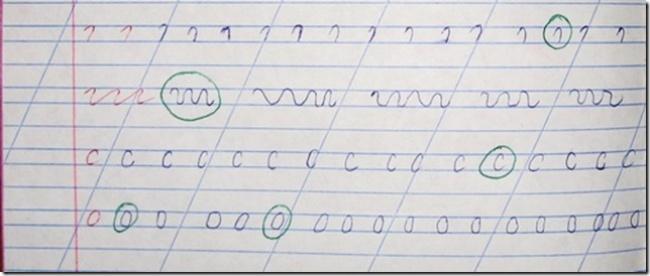
Have you noticed what’s different? I haven’t highlighted my daughter’s mistakes using a red pen — rather, I’ve used a green pen to highlight the lines where she’s done well. My daughter seemed to really enjoy this approach; she would always ask me, “Mom, which one did I do best?“ She was especially happy whenever I wrote the word ”perfect" next to something she had done.
What’s the difference between highlighting mistakes and focusing on achievements?
Well, what do you remember about how you used to get your mistakes highlighted by your teachers? Do you remember ever seeing what the correct answer or right way to do things was hidden behind all that red pen? Of course you didn’t. As a child, you automatically just focused on the red marks everywhere — and it didn’t feel good at all.
But what if we concentrate on the good parts of a child’s work? The child in this case feels something completely different, and consequently interprets what’s going on in their life differently. If children get to see where they did good, they will unconsciously strive to repeat it — they want that praise again. It’s a completely different approach which induces a completely different motivation for a child — not to avoid mistakes, but to strive to well.
But here’s an additional, and more important, question: how does highlighting a child’s mistakes go on to affect them in adulthood?
The answer’s fairly obvious. It’s in childhood that we often develop the tendency to focus on our shortcomings, on what we did wrong and what makes us ’bad’. We were helped a long way in this by our school teachers with their ever-present red pens, and by our parents who often spend more time telling us off for what we did wrong than for praising us for the things we got right.
So, this habit appears in childhood when it happens to us, and there’s no way we can shake it. So then we go on to repeat with the next generation. But all it leads to is generations of people focusing on the negative, and feeling unhappy with themselves — and in turn with life itself.
Just think about it hard for a second. Out of the 20 letters you wrote, they always highlighted the single one that was done poorly. But if you think about it logically, why on Earth do we emphasise the fact that a child wrote one poorly rather than praise them for getting 19 correct, if this is what it leads to?
What you focus on will develop into something more. Whatever your attention focuses on, that thing takes on more significance in yours and other people’s minds.
When you think about just how much of our experiences and first impressions from childhood we then pass on to our own offspring, it’s worth remembering that not all of that experience is positive. Our aim should always be to avoid doing the things that had a negative impact on us ourselves with those we love — above all our children.
So remember — maybe it’s time to start using the green pen rather than the red one. I guarantee you that even if you don’t point out mistakes to your children, they’ll gradually dissipate by themselves in this case — because your child will know how to strive for better.’
Source: Brighside.me
A leading expert on raising children recently pondered the question of how raising children’s awareness of the mistakes they make can influence their future interpretation of the world. Take a look — we think that there’s certainly something to think about here.
’My daughter didn’t really go to school at an early age — she was home schooled. When we did preparation exercises for handwriting, this is what her exercise book would look like:
Have you noticed what’s different? I haven’t highlighted my daughter’s mistakes using a red pen — rather, I’ve used a green pen to highlight the lines where she’s done well. My daughter seemed to really enjoy this approach; she would always ask me, “Mom, which one did I do best?“ She was especially happy whenever I wrote the word ”perfect" next to something she had done.
What’s the difference between highlighting mistakes and focusing on achievements?
Well, what do you remember about how you used to get your mistakes highlighted by your teachers? Do you remember ever seeing what the correct answer or right way to do things was hidden behind all that red pen? Of course you didn’t. As a child, you automatically just focused on the red marks everywhere — and it didn’t feel good at all.
But what if we concentrate on the good parts of a child’s work? The child in this case feels something completely different, and consequently interprets what’s going on in their life differently. If children get to see where they did good, they will unconsciously strive to repeat it — they want that praise again. It’s a completely different approach which induces a completely different motivation for a child — not to avoid mistakes, but to strive to well.
But here’s an additional, and more important, question: how does highlighting a child’s mistakes go on to affect them in adulthood?
The answer’s fairly obvious. It’s in childhood that we often develop the tendency to focus on our shortcomings, on what we did wrong and what makes us ’bad’. We were helped a long way in this by our school teachers with their ever-present red pens, and by our parents who often spend more time telling us off for what we did wrong than for praising us for the things we got right.
So, this habit appears in childhood when it happens to us, and there’s no way we can shake it. So then we go on to repeat with the next generation. But all it leads to is generations of people focusing on the negative, and feeling unhappy with themselves — and in turn with life itself.
Just think about it hard for a second. Out of the 20 letters you wrote, they always highlighted the single one that was done poorly. But if you think about it logically, why on Earth do we emphasise the fact that a child wrote one poorly rather than praise them for getting 19 correct, if this is what it leads to?
What you focus on will develop into something more. Whatever your attention focuses on, that thing takes on more significance in yours and other people’s minds.
When you think about just how much of our experiences and first impressions from childhood we then pass on to our own offspring, it’s worth remembering that not all of that experience is positive. Our aim should always be to avoid doing the things that had a negative impact on us ourselves with those we love — above all our children.
So remember — maybe it’s time to start using the green pen rather than the red one. I guarantee you that even if you don’t point out mistakes to your children, they’ll gradually dissipate by themselves in this case — because your child will know how to strive for better.’
Source: Brighside.me
Accedi oppure Registrati per commentare.


Commenti
D'altra parte, affinché una cosa del genere funzioni, si dev'essere quanto più possibile attenti ed imparziali nel giudicare i propri figli (anche quello positivo è, di fatto, un giudizio) altrimenti si rischia di creare solo confusione
(es. Se un giorno mi viene detto che questa 'c' è corretta e quest'altra 'c' no ma il giorno dopo mi si dice il contrario, non è detto che io ne deduca, come probabilmente farebbe una persona meno attenta, che sono corrette entrambe)
Tanto non ha effetti sul punteggio.