


Mia intervista a "La Repubblica" sulle emozioni e l'alessitimia

E' uscita oggi una mia intervista rilasciata a "La Repubblica" sulle emozioni e l'allessitimia (difficoltà nel comunicarle).
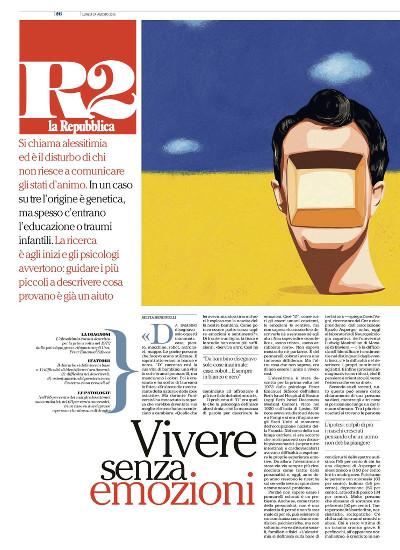
Potete vederla qui:
(nel box a sx "patologie" hanno invertito i termini, i dati corretti sono nel testo)
Né scusa né accusa. Addestrare le competenze, insegnare valori, e-ducare l'Uomo dalla Bestia. La Natura non è una scusa.
Post edited by wolfgang on
Accedi oppure Registrati per commentare.


Commenti
Continua così: scrivi, informa, fai conoscere !
Uhm.... sì.... l'avevo capito.... :-S
Io ancora mi nascondo sotto un nick anche se non ho quasi nulla da perdere (ho già perso quasi tutto).
Con la tua intervista, con il tuo esempio personale, sei riuscito per un attimo a farmi stare fuori da quel 85%.
Grazie.
Vedi che vai d' accordo con gli analisti ?
sui nickname in generale sono contrario, a parte i soliti autori narrativi che dicono di mettersi alla prova della critica.
Così faccio l'esempio di un mio conoscente, gay, che ha iniziato a pubblicare sotto uno pseudonimo in quanto la famiglia all'epoca non era al corrente della sua gaytudine. Ecco, dopo diversi hanni ha pubblicato un libro sul coming-out ...mantenendo lo pseudonimo.
Alla mia domanda se non trovasse paradossale la cosa, mi ha risposto che si, era corretto, ma ormai era conosciuto con quel nick e l'editore ha sconsigliato di tornare a nome e cognome originali. Insomma è diventata una vera e propria gabbia!
Anche io sto cercando dei modi per lavorare sull'alessitimia, che nel mio caso ha spesso raggiunto picchi abbastanza gravi.
“Behind every beautiful thing, there is some kind of pain” Bob Dylan
Divergent roles of autistic and alexithymic traits in utilitarian moral judgments in adults with autism
This study investigated hypothetical moral choices in adults with high-functioning autism and the role of empathy and alexithymia in such choices. We used a highly emotionally salient moral dilemma task to investigate autistics’ hypothetical moral evaluations about personally carrying out harmful utilitarian behaviours aimed at maximizing welfare. Results showed that they exhibited a normal pattern of moral judgments despite the deficits in social cognition and emotional processing. Further analyses revealed that this was due to mutually conflicting biases associated with autistic and alexithymic traits after accounting for shared variance: (a) autistic traits were associated with reduced utilitarian bias due to elevated personal distress of demanding social situations, while (b) alexithymic traits were associated with increased utilitarian bias on account of reduced empathic concern for the victim. Additionally, autistics relied on their non-verbal reasoning skills to rigidly abide by harm-norms. Thus, utilitarian moral judgments in autism were spared due to opposite influences of autistic and alexithymic traits and compensatory intellectual strategies. These findings demonstrate the importance of empathy and alexithymia in autistic moral cognition and have methodological implications for studying moral judgments in several other clinical populations.
http://www.nature.com/articles/srep23637
It has been proposed that Autism Spectrum Disorder (ASD) is associated with difficulties perceiving the internal state of one's body (i.e., impaired interoception), causing the socio-emotional deficits which are a diagnostic feature of the condition. However, research indicates that alexithymia – characterized by difficulties in recognizing emotions from internal bodily sensations – is also linked to atypical interoception. Elevated rates of alexithymia in the autistic population have been shown to underpin several socio-emotional impairments thought to be symptomatic of ASD, raising the possibility that interoceptive difficulties in ASD are also due to co-occurring alexithymia. Following this line of inquiry, the present study examined the relative impact of alexithymia and autism on interoceptive accuracy (IA). Across two experiments, it was found that alexithymia, not autism, was associated with atypical interoception. Results indicate that interoceptive impairments should not be considered a feature of ASD, but instead due to co-occurring alexithymia.